A perforated aluminum panel is 3003-H14 plate punched with a repeating hole field. A laser-cut metal screen is the same plate cut along a vector graphic. For exterior shading on 2.0–3.0 mm veneer with PVDF ≥ 30 μm to AAMA 2605, LINDELACR uses punch for regular grids and laser only when the artwork cannot be punched.
Punch vs laser: what the specifier is actually buying
Architects often write “perforated metal screen” for any hole in a plate. The factory does not. A turret or CNC punch indexes a tool—round, square, slot—and stamps a field. A fiber laser follows a DXF or DWG path and burns the leftover metal away. Both can live on a solid aluminum rainscreen. They do not share cycle time, edge quality, or how much plate remains to carry wind.
That choice sits inside the same customized-for-you split LINDELACR uses on landmark cladding: lock the pattern and remaining section first, then nest, fold, and coat. A pretty render with no hole diameter, pitch, or open-area target is not a bid package.
| Item | Perforated aluminum panel (punch) | Laser-cut metal screen |
|---|---|---|
| Process | Turret / CNC punch, repeating tool | Fiber laser on a vector path |
| Typical pattern | Round, square, slot; staggered or aligned | Logos, maps, irregular motifs |
| Open area | Set by hole size + pitch (often 10–40% on facades) | Set by the artwork; must still leave load paths |
| Speed on large fields | Faster once the tool is set | Slower as cut length grows |
| Cut edge | Cold-sheared hole; coat after pretreatment | Heat-affected edge; grind/coat so corrosion does not start in the kerf |
| Best use | Sunshade, parking, plant-room, regular rainscreen | One-off graphics that a punch cannot index |
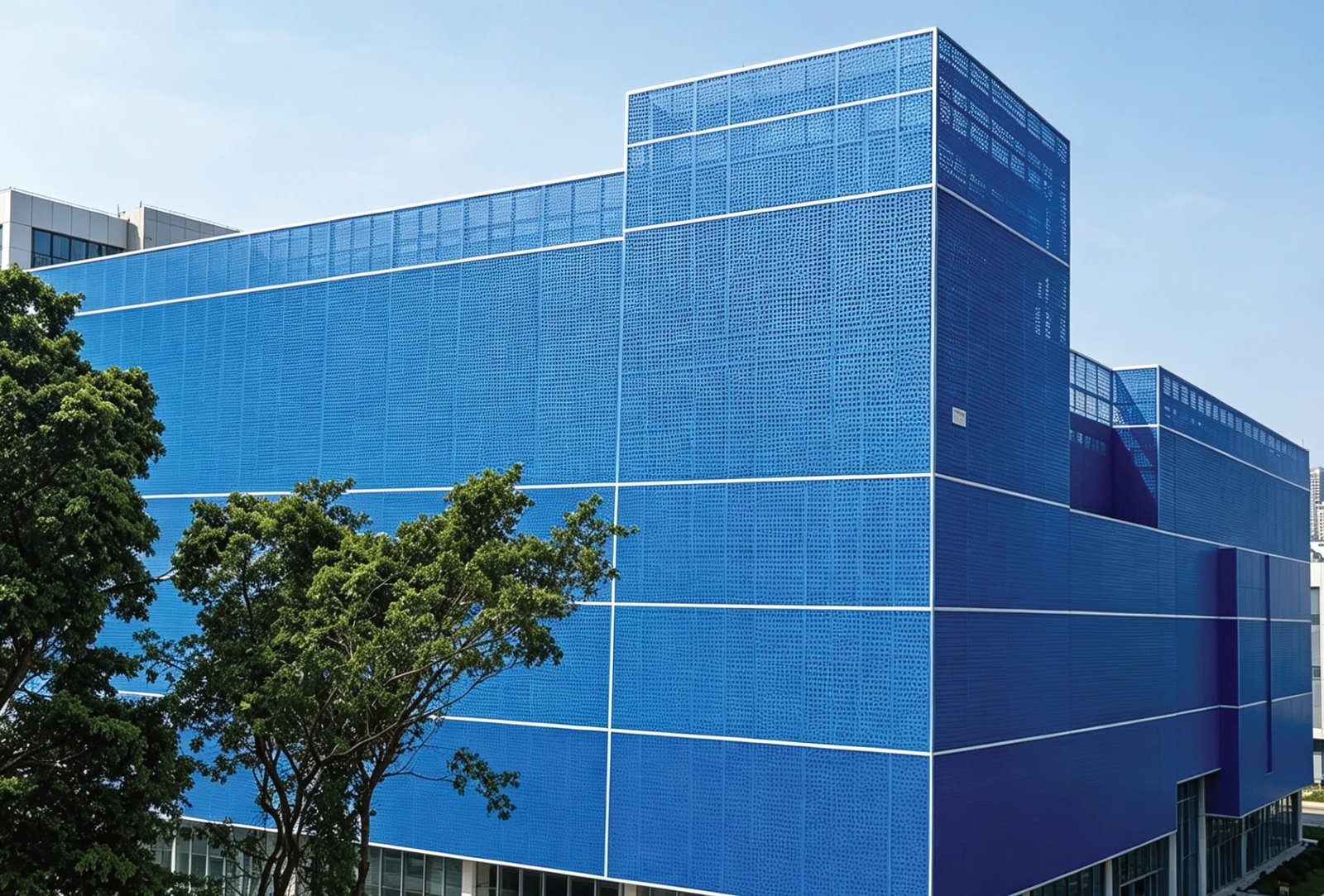
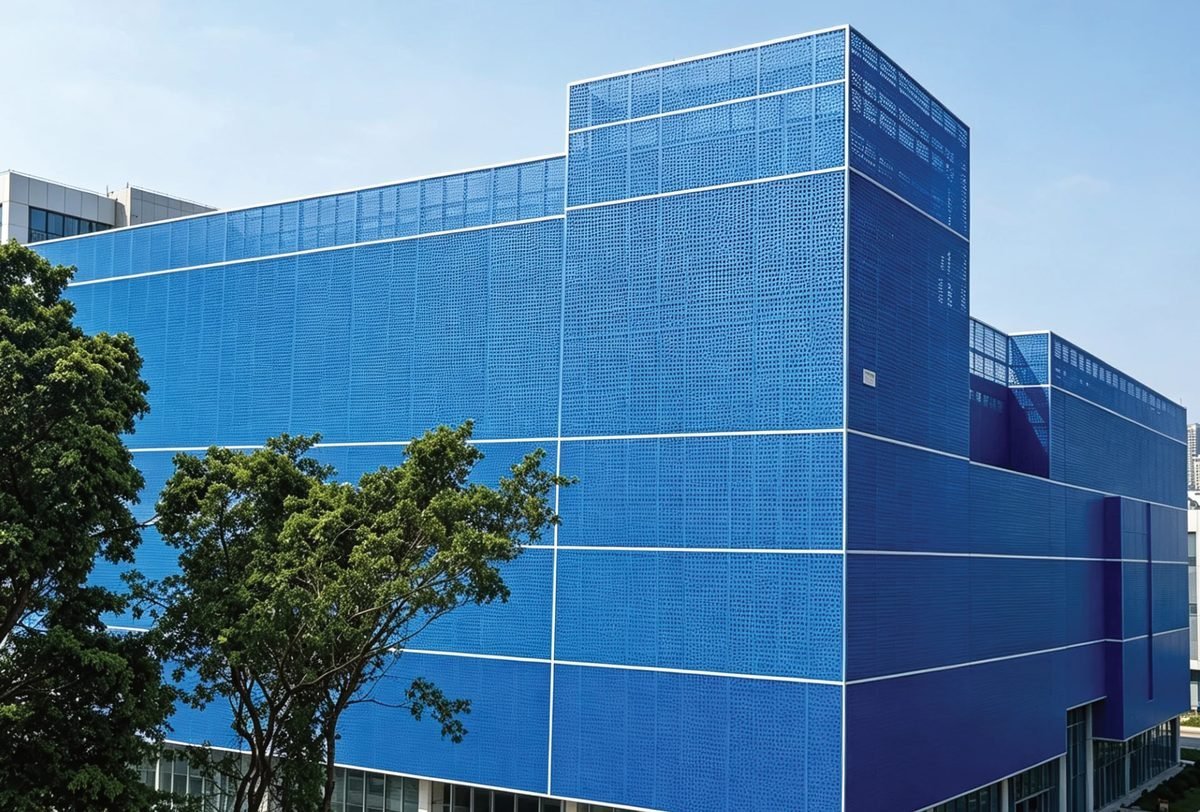
The blue elevation in the photograph is a punch field: square holes, even pitch, white joint grid. That is facade metal, not a construction safety mesh and not a laser picture cut into every cassette.
Hard parameters for exterior perforated aluminum
A hole field does not change the alloy logic. LINDELACR’s standard perforated panel is still solid plate—typically 3003-H14—not an ACP skin with holes printed on a 0.5 mm face.
| Parameter | LINDELACR typical spec |
|---|---|
| Exterior alloy | 3003-H14 solid aluminum plate |
| Simple interior / low-wind screens | 1100 where span and fold allow |
| Exterior thickness | Typically 2.0–3.0 mm (not ACP 0.5 mm skins) |
| Facade hole field | Common φ3–φ12 mm round, or square/slot to the drawing; pitch sets open area |
| Open area (shade / vent) | Specified by the architect; factory checks remaining ligaments for wind |
| Exposed coating | PVDF to AAMA 2605; dry film ≥ 30 μm (holes and folds pretreated) |
| Interior / sheltered coating | Powder to AAMA 2604; typical DFT 60–80 μm |
| Fire | Aluminum substrate is non-combustible; system class follows the tested assembly (ASTM E84 / project GB 8624)—not a catalog stamp on a hole pattern |
| Wind / suction | Calculated from remaining section, cassette size, return depth, and bracket spacing; no generic kPa copied onto a render |
| Plant / QA | Foshan 20,000 m²; 1,000+ engineering projects; ISO 9001 plant QA |
Punching removes metal. A 35% open field on 2.0 mm plate is not as stiff as a solid 2.0 mm cassette of the same module. If the elevation is a parking podium or a high-wind corner, increase thickness, tighten pitch, or deepen the return—do not “just laser it larger.”
Step-by-step: how to specify punch or laser
1. State the job of the screen. Shade a glass wall, hide MEP, or carry a graphic. Ventilation and glare control want a calculated open area. Branding wants a vector.
2. Pick the process from the pattern, not the mood board. Repeating φ6 mm at 12 mm pitch is a punch. A city map across six cassettes is a laser. Mixing both on one elevation is fine if joints hide the process change.
3. Lock remaining ligaments. Between holes, leave enough metal for the module size and the wind zone. LINDELACR will reject a DXF that leaves 3 mm slivers across a 1.5 m cassette.
4. Fold, then coat. Returns become the cassette. Pretreatment must reach punched walls and laser kerfs before PVDF or powder, or the first corrosion sits inside the hole, not on the face.
5. Sample the field, not only the color chip. A 1:1 panel shows hole ovality after folding, coating fill at the cut, and how the joint reads against glass. Only then does the line run the remaining elevation.
Factory insight: cost, MOQ, and what actually delays a screen
Punch cost drops as the same tool repeats. Laser cost rises with cut length. A 20,000 m² Foshan plant can run both; the quote still follows the nest. A repeating square-hole field on 3003-H14 coats as one lot. A laser mural with hundreds of unique islands waits on programming and a signed sample, not on “CNC minutes.”
What delays hotel and civic jobs is an open-area target with no pitch, or a PNG logo with no minimum ligament. Send diameter + pitch, or a clean vector with a minimum web. LINDELACR keeps punch, laser, brake, and the PVDF line in one plant so the team that nested the field is the team that checks the first crate.
MOQ is a coating-batch problem more than a hole-count problem. A small graphic screen can still wait on a PVDF color that is not already on the line. Ask for the alloy, the process, and the coating class in one RFQ so the sample leaves Foshan with the same film the elevation will wear.
Frequently asked questions
Is a perforated aluminum panel the same as a laser-cut metal screen?
No. Punching stamps a repeating hole field (round, square, slot) on 3003-H14 plate. Laser cutting follows a vector graphic. Same alloy and 2.0–3.0 mm exterior gauge can be used; the process, edge, cost, and wind remaining-section are different.
Which process should a specifier write for a sunshade facade?
Write punch when the elevation is a regular grid and you need a calculated open area. Write laser when the artwork is a logo, map, or one-off motif that a turret cannot index. LINDELACR still coats both to AAMA 2605 PVDF ≥ 30 μm on exterior plate.
What thickness and coating apply to exterior perforated aluminum?
Exterior rainscreens and sunshades: 3003-H14 solid aluminum, typically 2.0–3.0 mm, PVDF to AAMA 2605 with dry film ≥ 30 μm. Interior decorative screens may use 1100 and powder to AAMA 2604. Wind is calculated from remaining section, fold depth, and brackets—not a catalog kPa.
What files should the architect send for a factory quote?
Send the elevation, hole diameter and pitch or the vector artwork, target open area, finish, and whether the screen is exterior. LINDELACR returns a punch-or-laser note, nest, sample plan, and lead time from the 20,000 m² Foshan plant.
Send the hole field before the render is frozen
If the facade is a regular grid, write punch, 3003-H14, 2.0–3.0 mm, and PVDF ≥ 30 μm. If it is a graphic, send the vector. LINDELACR will tell you which process holds the wind path and when a 1:1 sample can leave Foshan.