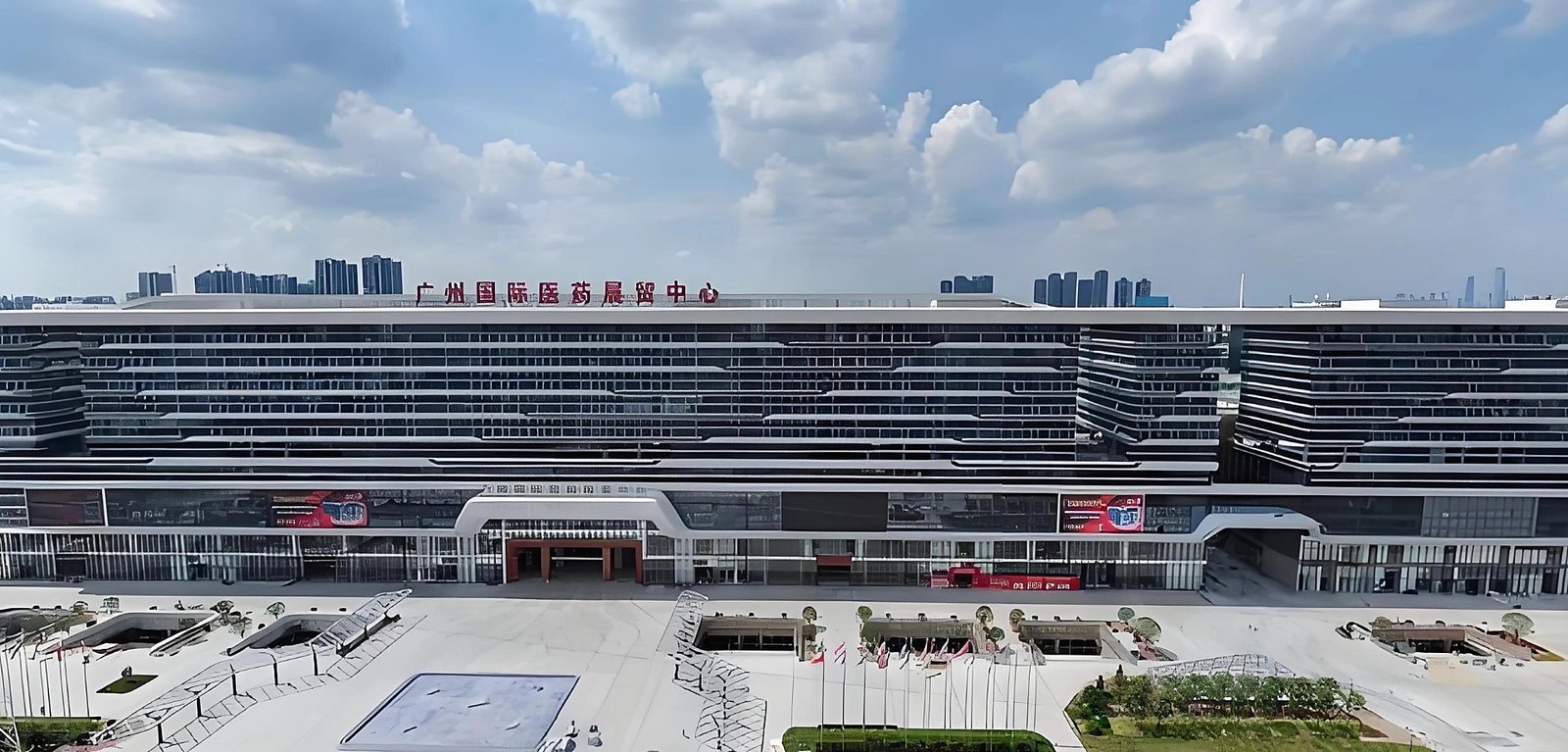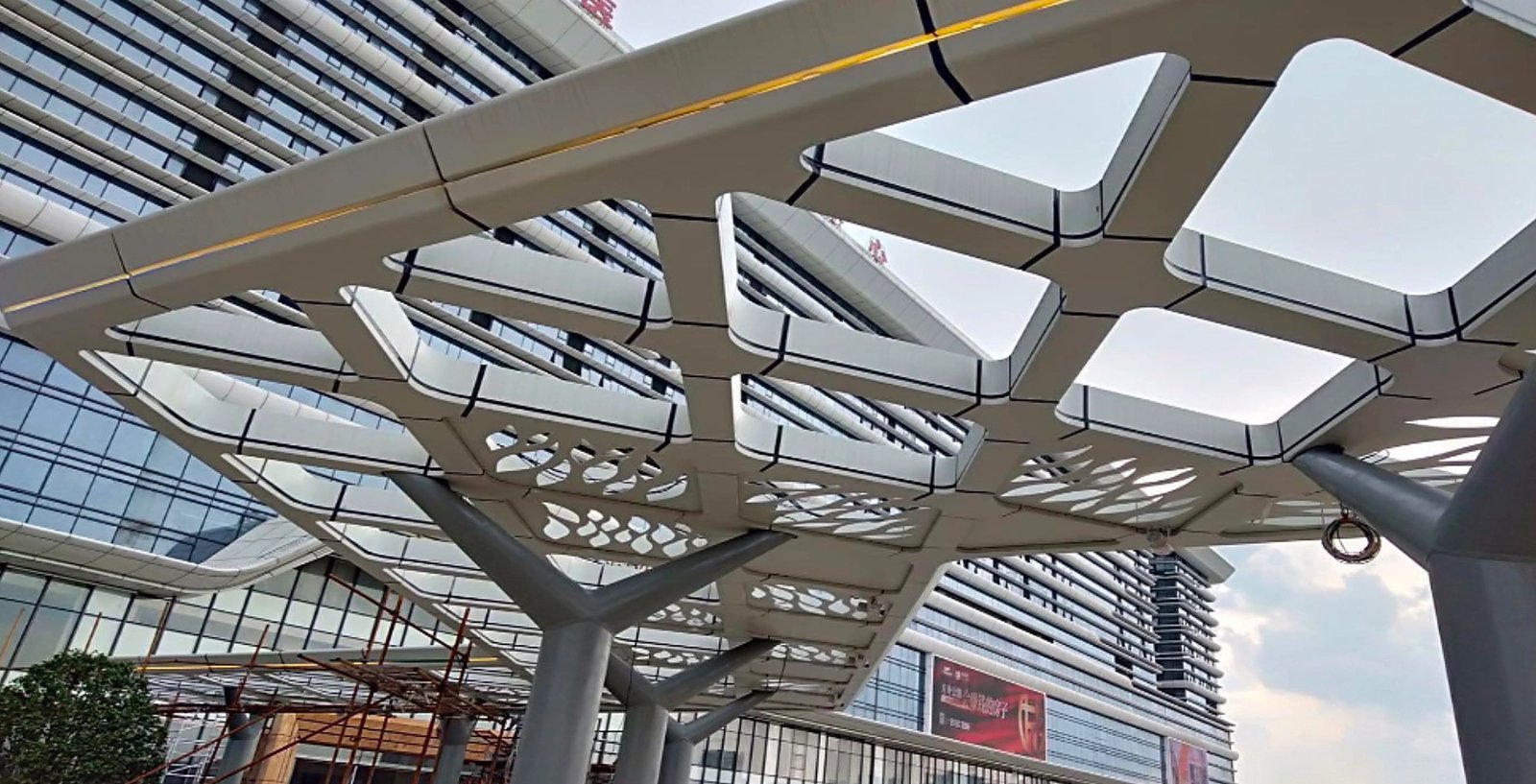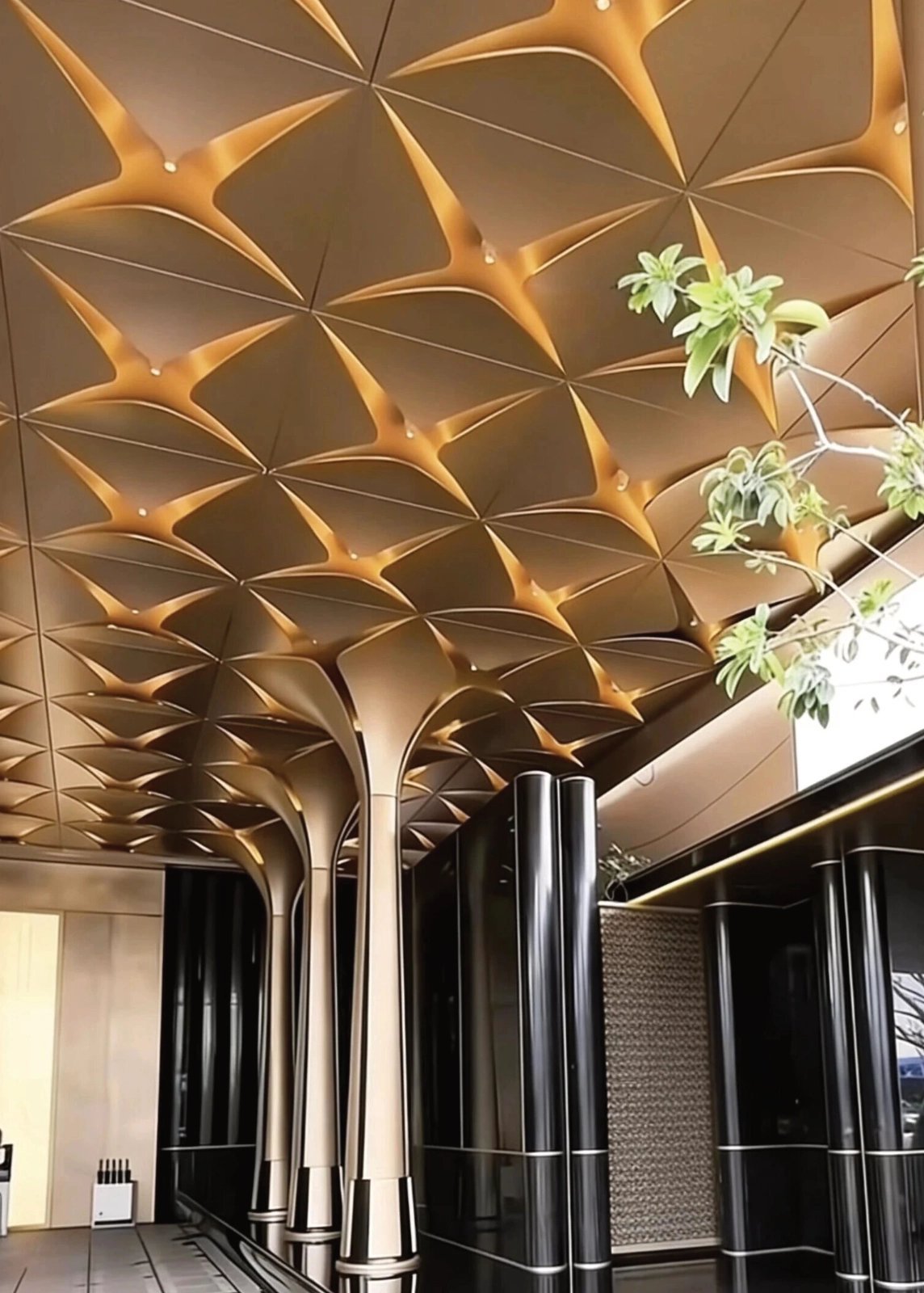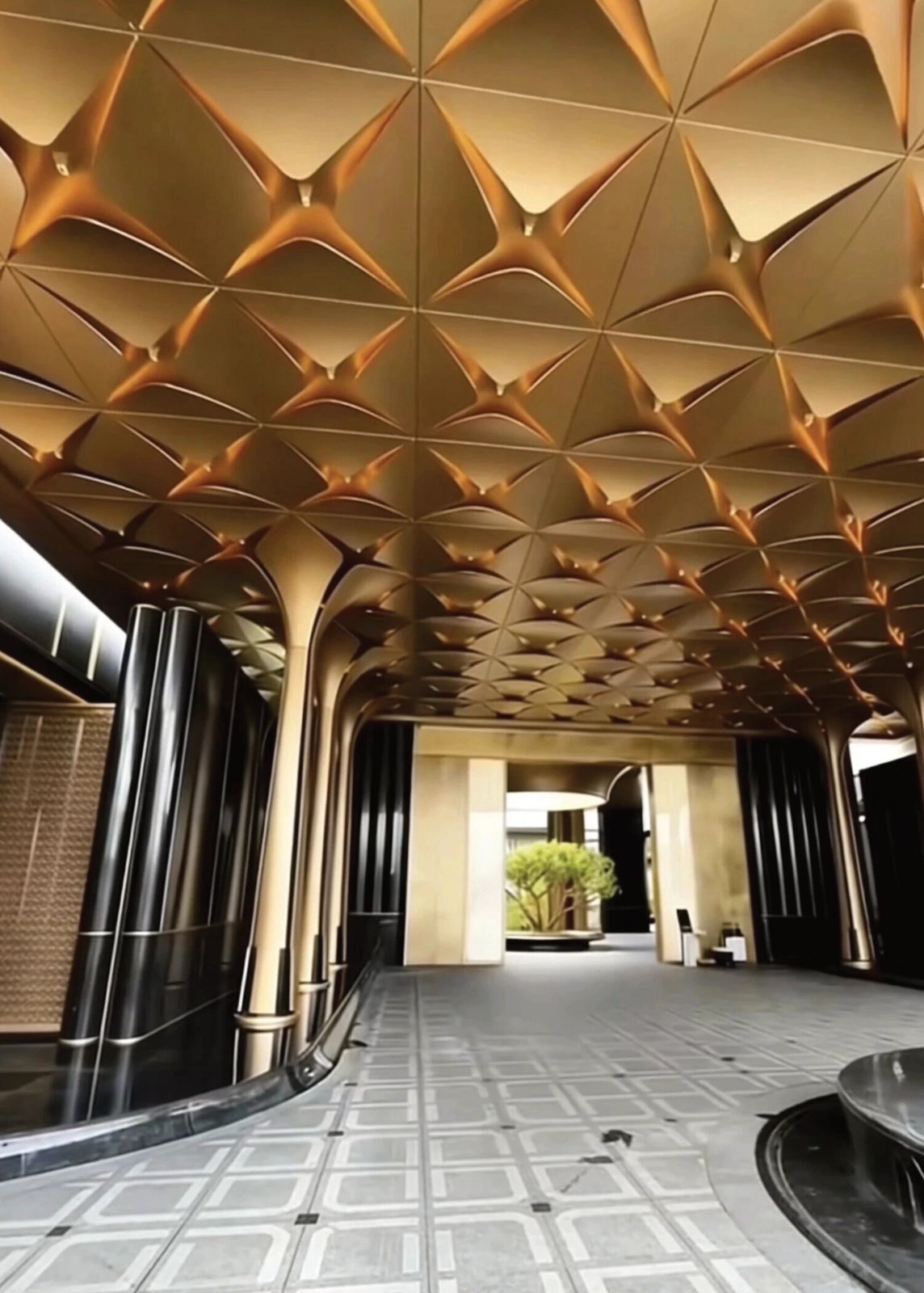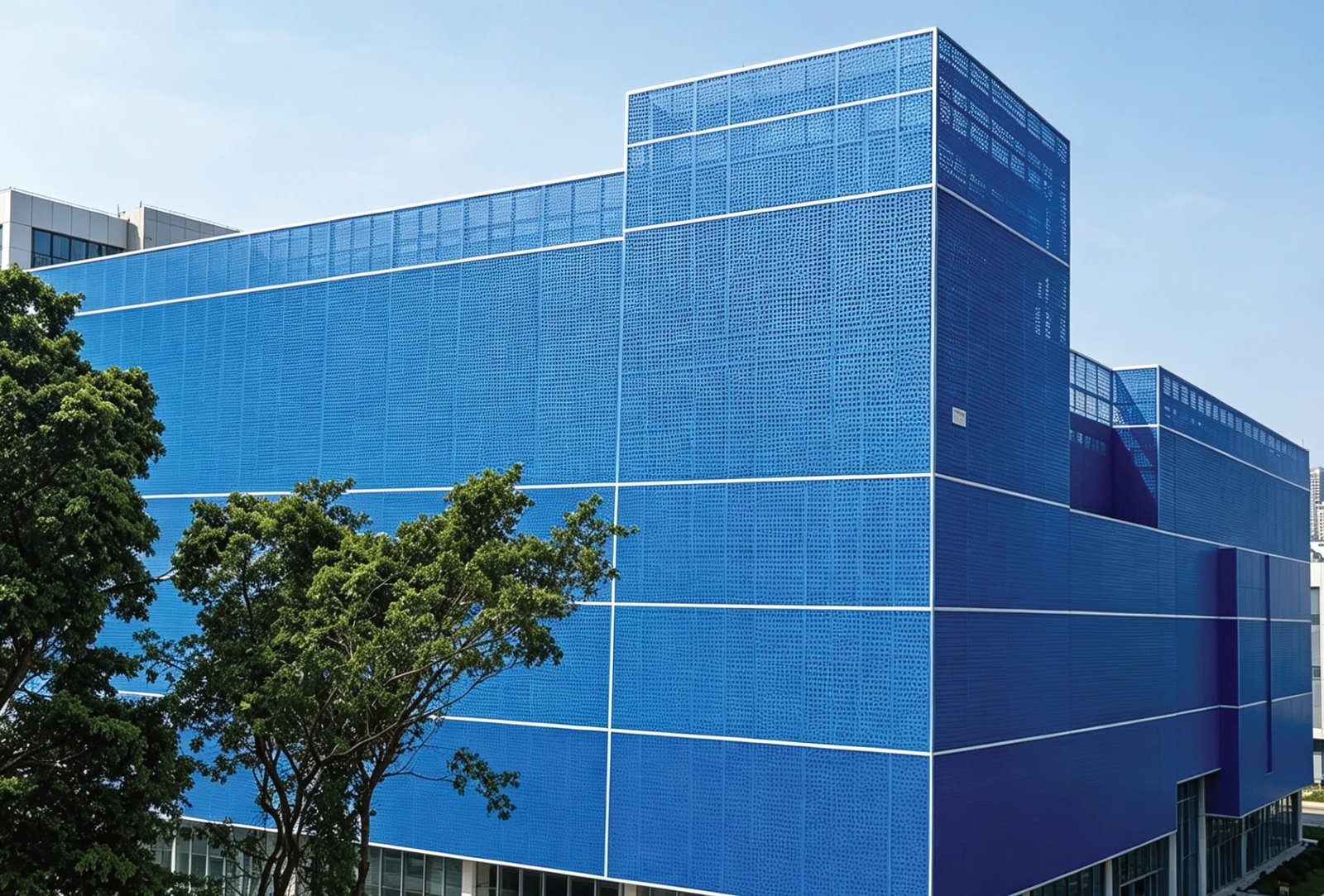
A 3D point cloud sizes each cassette on an irregular landmark before coil is coated. LINDELACR overlays unique unfolds, then cuts 3003-H14 plate—typically 2.0–3.0 mm. Exposed mall, stadium, and curtain-wall trays take PVDF AAMA 2605 ≥ 30 μm; airport and hospital interiors take powder AAMA 2604.
The cloud is the surface; the split is the ticket
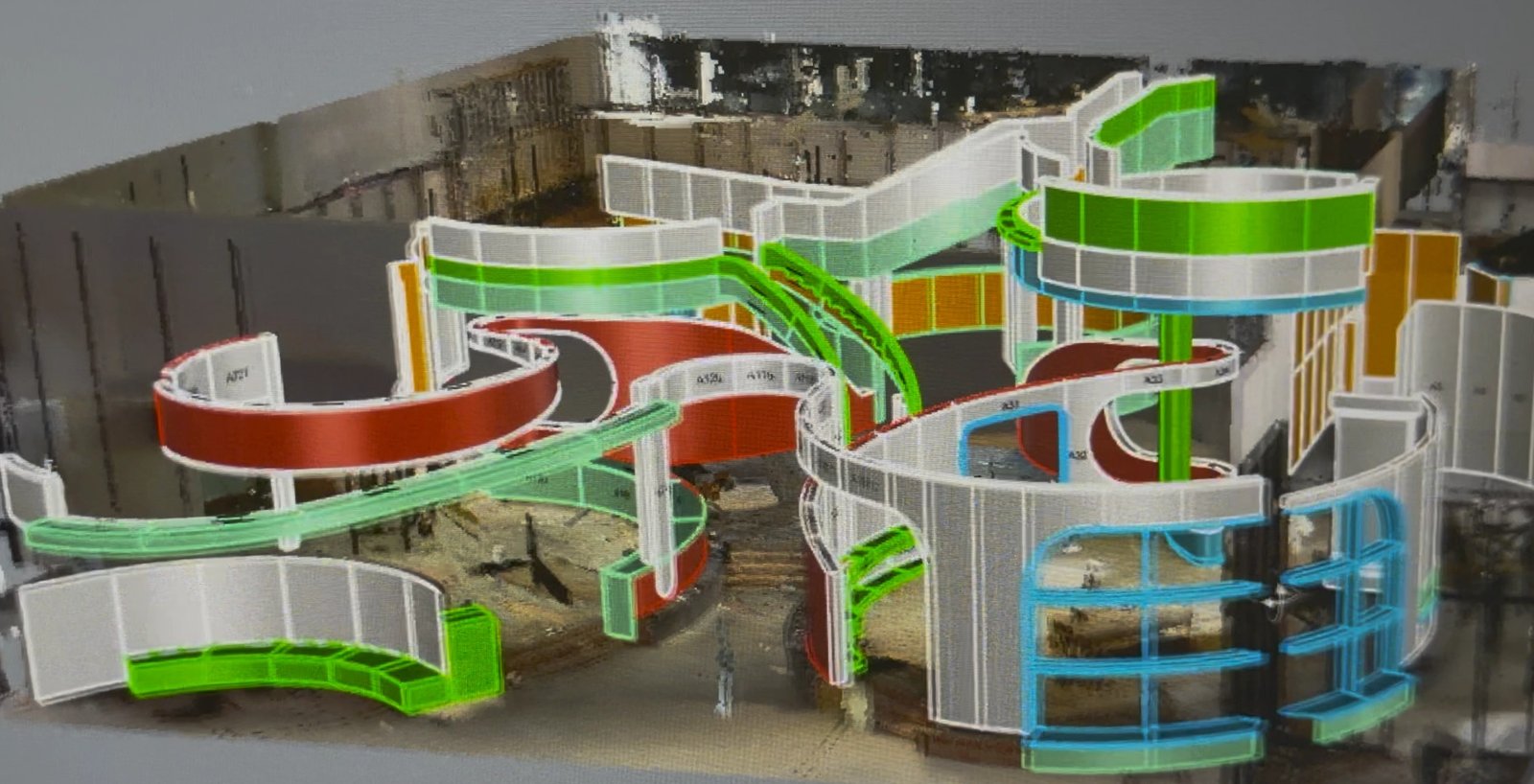
Irregular landmarks fail between survey points. A total station sets control. It does not record a sweeping soffit, a compound wall, or a spiral that a 20–25 mm cassette return must follow. LiDAR puts millions of XYZ hits on that surface. LINDELACR imports the cloud, overlays the architectural intent, and freezes a unique unfold per tray—then CNC, then the brake. That is the customized-for-you hold point before coil is allocated.
The scan overlay on this ticket is an irregular interior: curved walls, ramps, and coded fields such as A121, A125, and A32 sitting on the measured mesh. Those codes are the nest, not a brochure texture. Adjacent trays that share a hue must share one coating lot after they leave the brake. LINDELACR will not invent a kPa or a drawing number that is not on that overlay.
| Plane from the 7-day query | Exposure | LINDELACR default |
|---|---|---|
| 3.0 mm PVDF-coated custom-shaped aluminum veneer | Long shaped bay / carved remaining section | 3003-H14 solid plate, typically 2.0–3.0 mm; 3.0 mm where the unfold needs it |
| PVDF-coated shaped veneer for shopping mall / stadium / curtain wall | Weather, sun, street face | PVDF to AAMA 2605; dry film ≥ 30 μm |
| Powder-coated shaped veneer for airport / hospital | Sheltered hall, wipeable interior | Architectural powder to AAMA 2604 |
| Weather-resistant powder-coated shaped veneer | Sheltered only | AAMA 2604-class film—not a fluorocarbon substitute on a west mall soffit |
| Build-up | — | Solid aluminum, no ACP 0.5 mm skins |
| Return | — | Typically 20–25 mm shop fold |
| Plant | — | Foshan 20,000 m²; 1,000+ engineering projects |
A stadium soffit and a mall street canopy take the same outdoor language as a curtain-wall rainscreen: 3.0 mm PVDF-coated custom-shaped aluminum veneer on solid plate. A hospital corridor and an airport interior do not. Weather-resistant powder-coated shaped aluminum veneer is specified when the plane is sheltered. It is not a cheaper PVDF on a west-facing mall soffit that sees rain all afternoon.
Airport Terminal 3: a sheltered hall, not a glass ticket
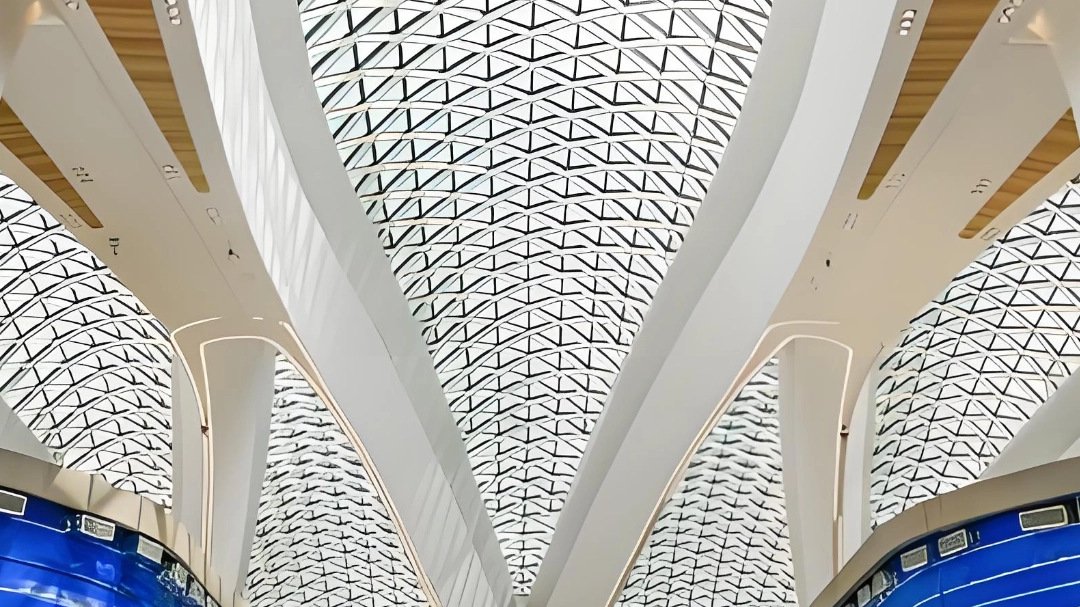
The Terminal 3 hall in the plant photos reads as white custom-shaped soffits, wood-look strips, and blue cylindrical drums under a diagrid skylight. LINDELACR does not claim that glass grid. The metal language the camera can hang is the white shaped aluminum—an interior, closed hall. Powder to AAMA 2604 on a wipeable film is the default for that plane, the same interior ticket as powder-coated aluminum veneer for hospital corridors. Exterior curtain-wall trays on the same campus, if they take weather, switch to PVDF AAMA 2605 and usually 3.0 mm 3003-H14. Two lots. Two nests. One cloud if the as-built still governs.
Alloy 1100 stays on simple low-wind interiors. Compound soffits and long shaped bays stay on 3003-H14. Thickness is typically 2.0–3.0 mm; 3.0 mm where the remaining section after a fold or a carved opening is the stiffener. Wind is sized from plate, return, and hanger spacing—not a catalog kPa copied from another bay. Unique hyperbolic or compound faces are a hyperbolic panel nest, not a repeating flat cassette.
CNC and the brake follow the coded unfold
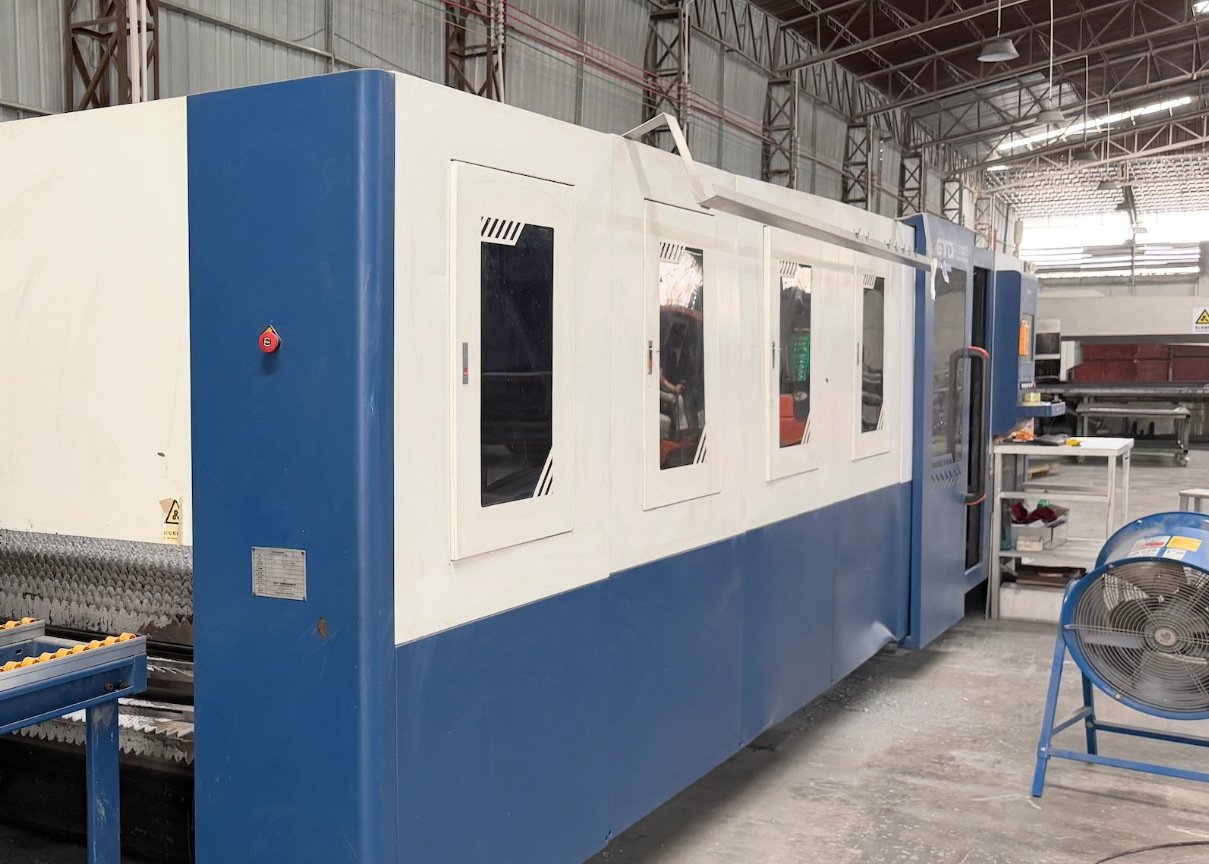
Once the overlay is locked, the blank is a CNC cut from solid plate—not a 0.5 mm ACP skin. The enclosure in Foshan is the cut hold point: the unique outline from the cloud, including holes that will become hangers. Single-curved trays go to the brake. Compound faces get a first-article fit against the BIM split before the rest of the set is released.
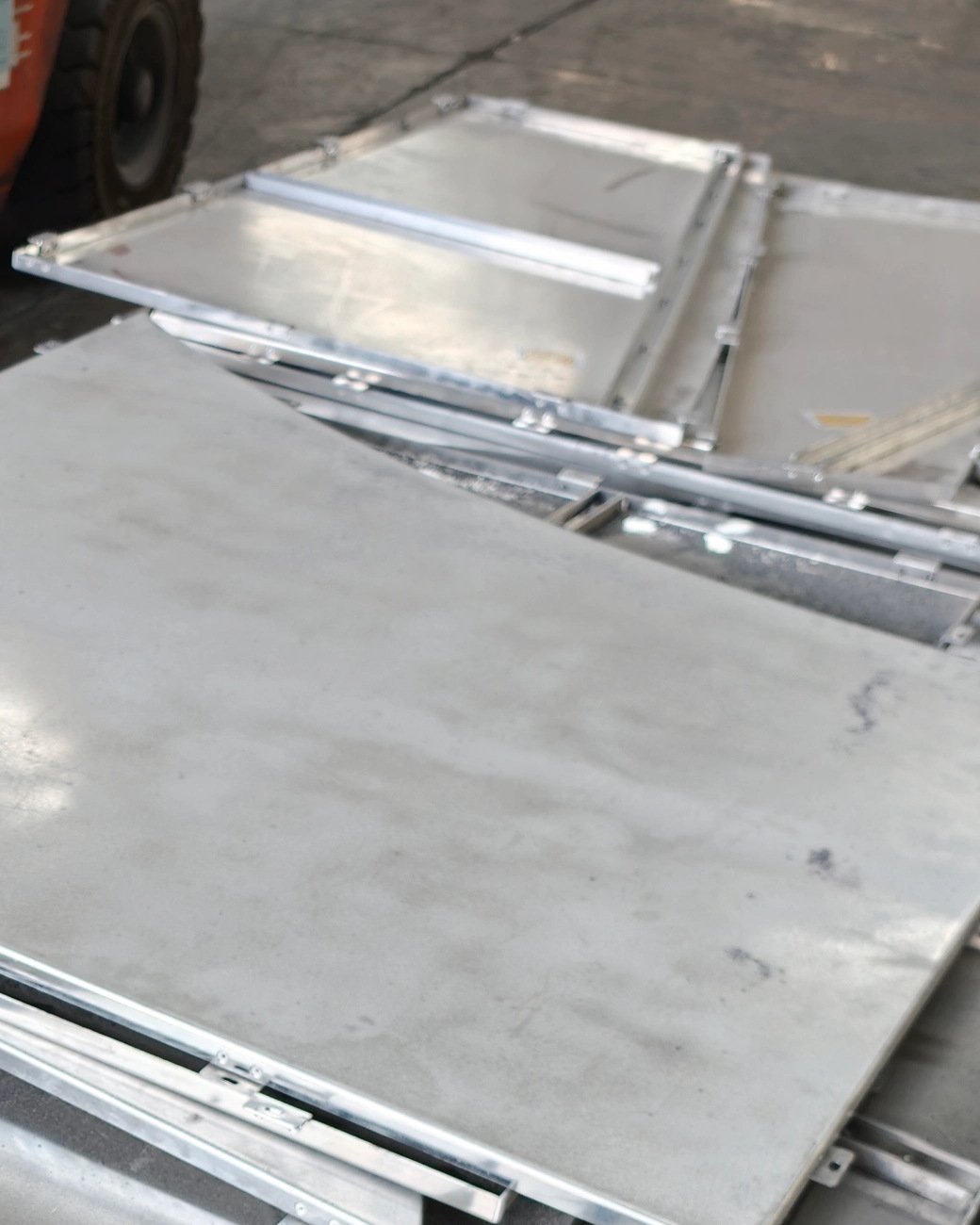
After the brake the cassette is still mill finish: shop return typically 20–25 mm, hanger slots in the flange, faces stacked for grind and one coating lot. PVDF or powder is chosen by the exposure column in the table above, not by the building’s nickname. A powder-coated shaped aluminum veneer for a stadium bowl that is open to rain is the wrong lot. A 3.0 mm PVDF-coated weather-resistant claim that is actually a thin PE film is also the wrong lot.
Scan → overlay → coded unfold → CNC → fold → grind → one PVDF or powder lot → crate by zone. That sequence is how a point cloud becomes a hangable irregular landmark, and how the 7-day queries (mall, stadium, curtain wall, airport, hospital) become two coating classes instead of one white render.
Frequently asked questions
How does 3D point cloud technology help in designing facades for irregular-shaped landmark buildings?
The cloud is the measured surface. LINDELACR overlays unique unfolds on it, codes each tray, then CNC-cuts 3003-H14 solid plate—typically 2.0–3.0 mm, with 3.0 mm where a shaped bay or return leaves less remaining section. Tape and a stale IFC miss slab bow between control points. The cloud does not.
When does a point-cloud split call for 3.0 mm PVDF instead of powder on shaped aluminum veneer?
PVDF to AAMA 2605, dry film ≥ 30 μm, is the exposed ticket: stadium soffit, mall street face, curtain-wall rainscreen. Architectural powder to AAMA 2604 is for sheltered halls—airport interiors and hospital corridors. Weather-resistant powder is a real film on a sheltered plane, not a fluorocarbon substitute on a west mall soffit.
What coating belongs on airport, hospital, mall, and stadium aluminum veneer?
Airport Terminal 3 interiors in the plant photos are a closed hall: powder AAMA 2604 on wipeable shaped soffits. Hospital interiors follow the same interior ticket. Mall street faces, stadium rainscreens, and curtain-wall trays that take weather take 3.0 mm PVDF AAMA 2605 on 3003-H14. Do not run both as one lot unless the drawing names two lots.
How do numbered trays get from the point cloud to CNC and the brake?
The overlay freezes a unique unfold and a code—A121, A125, A32 in the scan on this ticket. CNC cuts that blank from solid plate. The brake folds a typical 20–25 mm return. Then one coating lot. LINDELACR does not publish a fake millimetre tolerance or a catalog kPa on every carved or compound bay.
Request a scan split, 3.0 mm samples, and shop drawings
Send the point cloud or permission to scan, whether the plane is rainscreen or a sheltered hall, and a coating chip. LINDELACR will return a coded tray split, a 2.0 or 3.0 mm note, a PVDF or powder class, and a coated sample from the 20,000 m² Foshan plant.