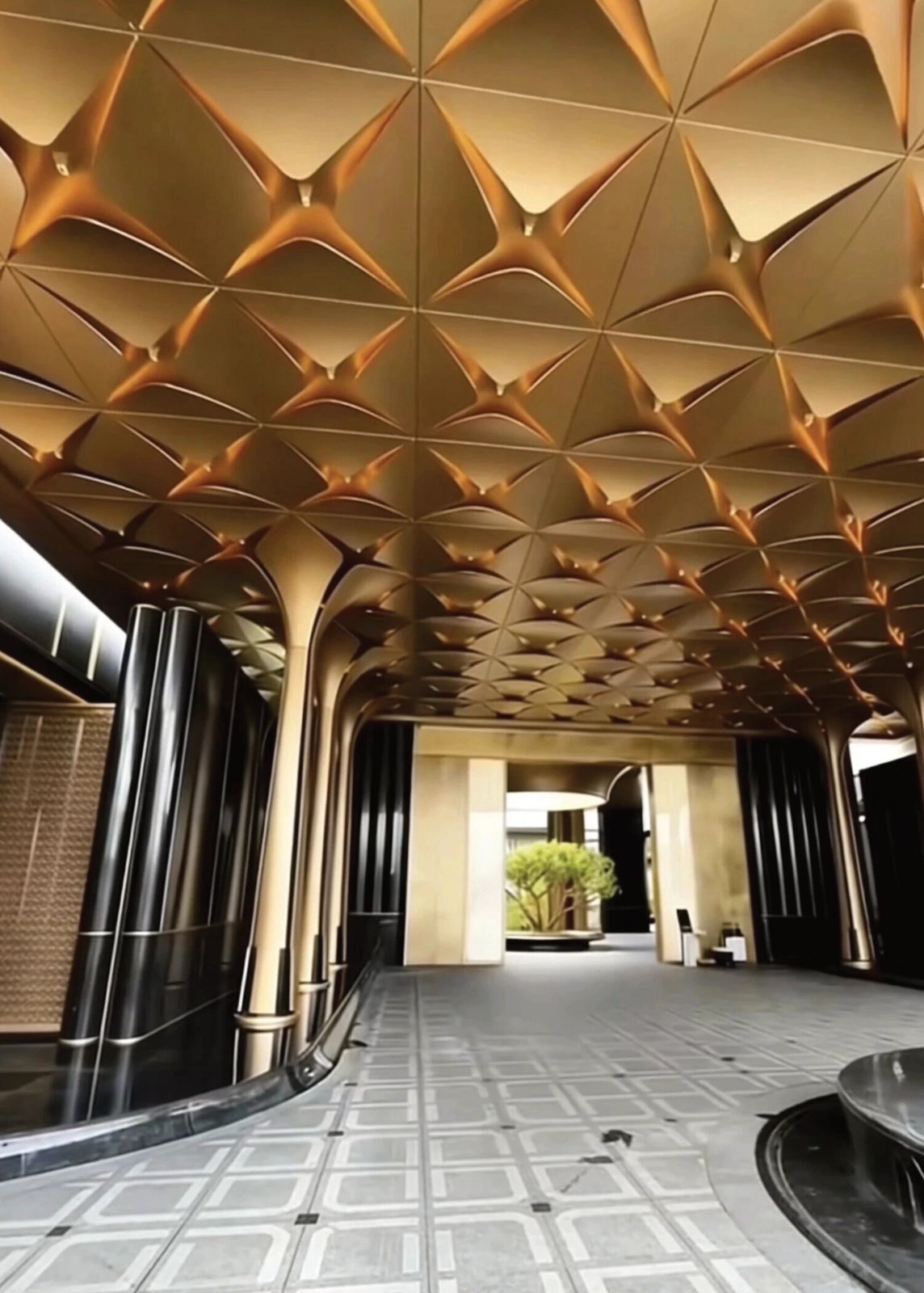
LINDELACR supplied Thailand Golden Bay Resort Hotel with 1,800 m² of champagne-gold 3D petal ceiling and sixteen flared aluminum column covers. The Foshan factory advised the design, surveyed the lobby, scanned the scene, issued samples, then numbered every crate so a Thai crew could hang coded modules with factory-fitted corner brackets.
The gold lobby: petals, glass, and sixteen shafts
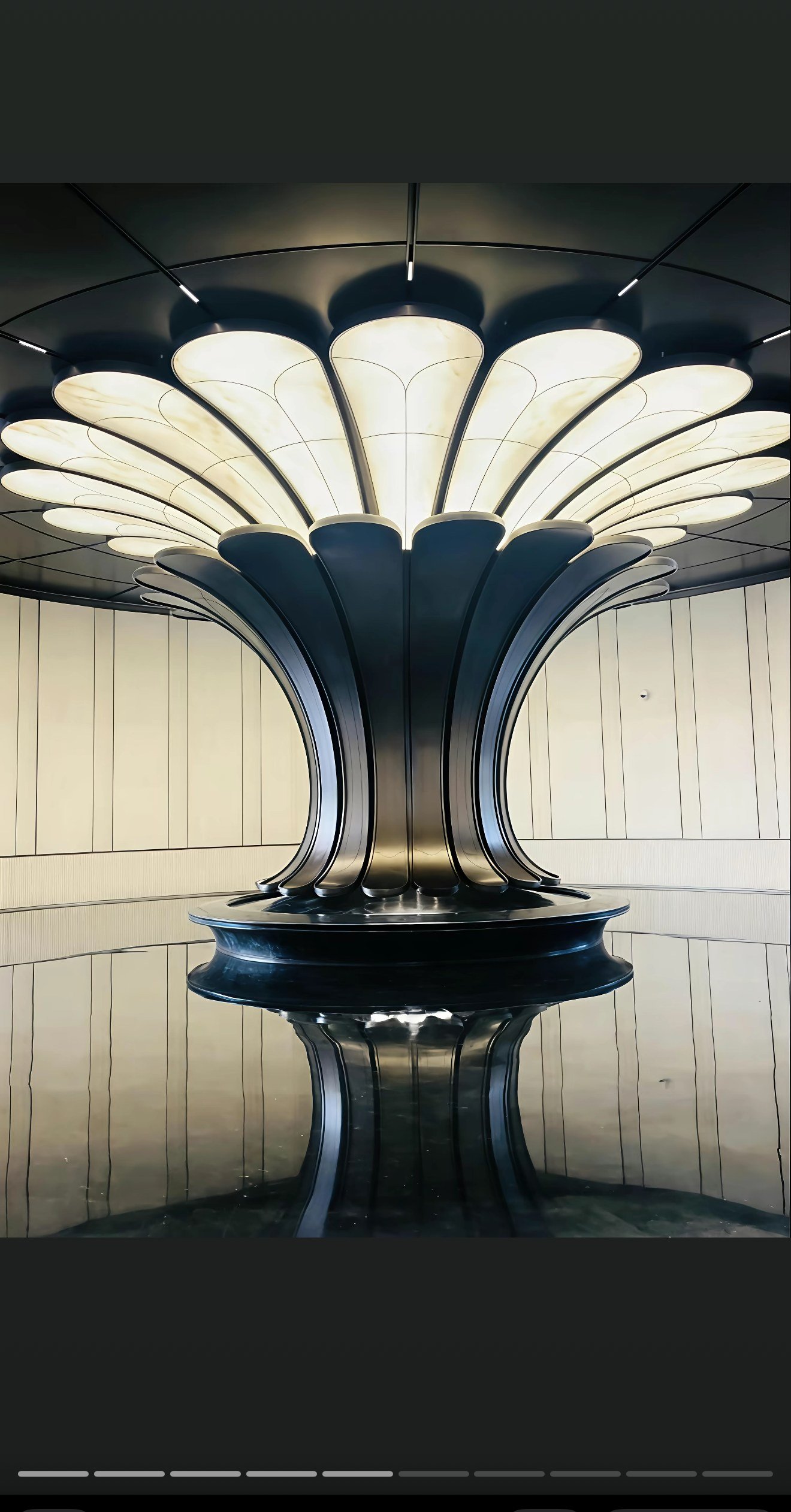
Thailand Golden Bay Resort Hotel (泰国金海湾度假酒店) wanted a lobby that photographs as one canopy: not a flat grid dropped over box columns. LINDELACR treated the soffit and the shafts as one file. Four-petal aluminum modules tile the plane in champagne gold. Lights sit in the junctions. Sixteen columns rise in a dark or gold shaft, then flare into the same petal field so the capital is part of the ceiling, not a hat glued under it.
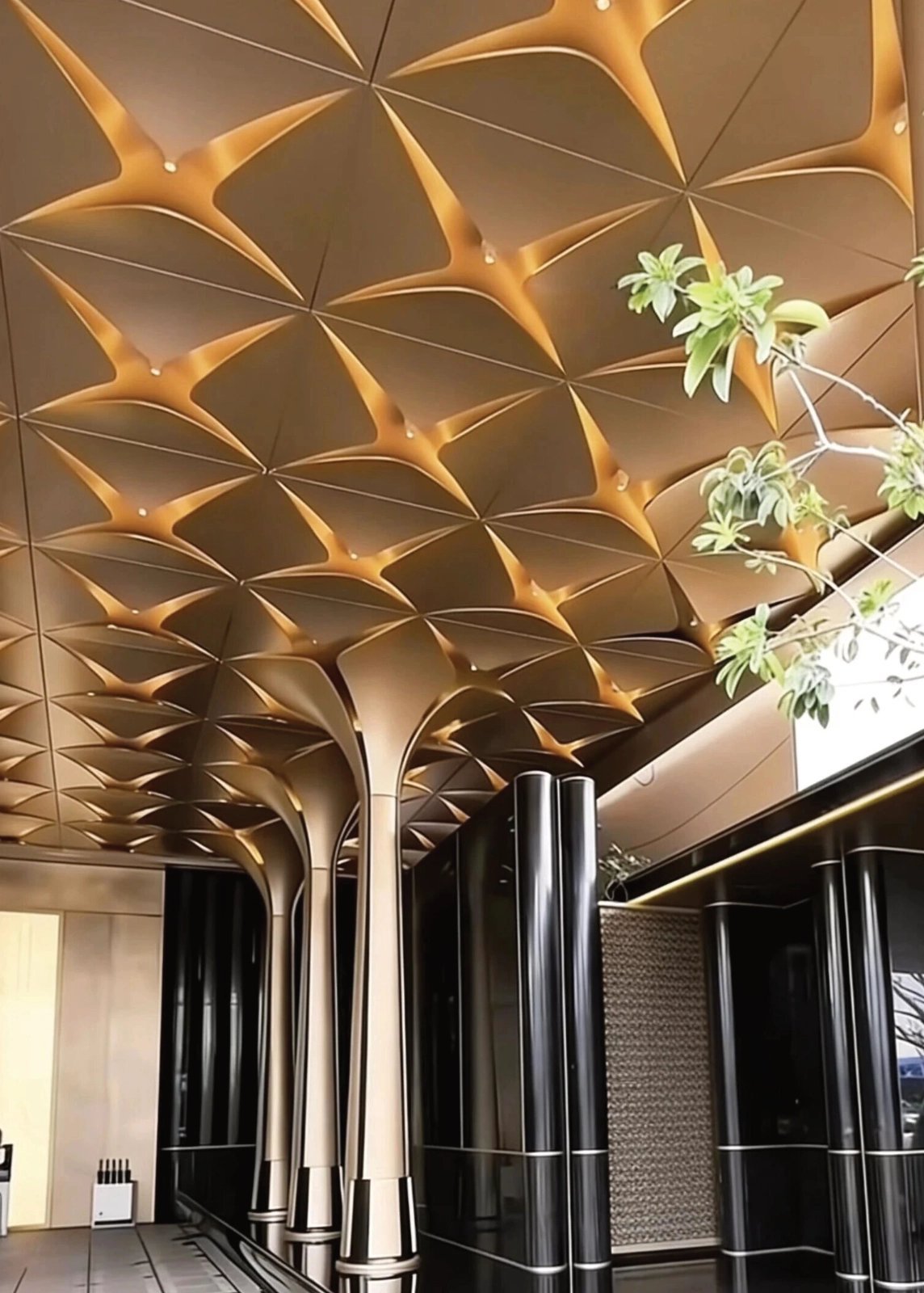
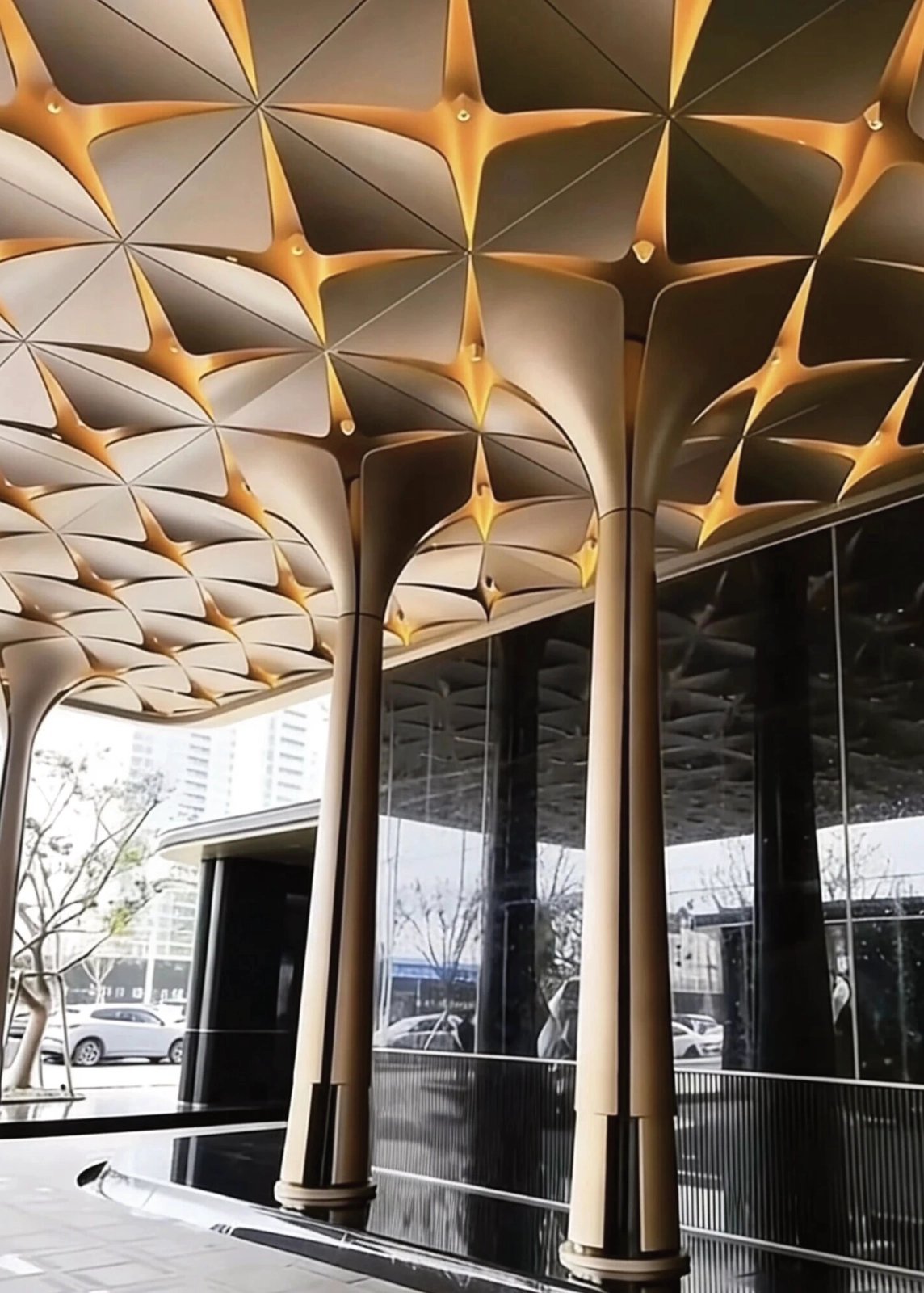
The courtyard and glass wall are why gold works here. Daylight hits the petals from the garden; the metal has to hold hue when the sun moves, then read warm after dark when the junction lights take over. That is a coating-batch problem and a geometry problem, not a paint-chip problem. The work sits on LINDELACR’s customized-for-you path: measure what is already there, freeze a shop drawing, fabricate in Foshan, guide hang abroad.
Project snapshot
| Item | Thailand Golden Bay Resort Hotel |
|---|---|
| Ceiling | 1,800 m² champagne-gold 3D petal aluminum |
| Columns | 16 flared aluminum covers |
| Lights | Auto-sensing fixtures in petal junctions; brightness follows outdoor ambient |
| LINDELACR role | Design advice, survey, 3D scan, samples, numbered crates, install guidance |
| Plant | Foshan, 20,000 m²; 1,000+ engineering projects |
Those five lines are the bid sheet. Thickness, alloy, and wind live in the shop file, not in a brochure kPa. What the owner sees is the gold field and the sixteen flares landing clean against glass. LINDELACR’s survey and 3D scan exist so the flare is a restore of that lobby—glass line, shaft positions, soffit height—not a cone copied from another hotel. Scene restore is why a capital can meet a petal module without a shadow gap the camera will find.
What LINDELACR actually did
The factory did not drop a catalog crate. Design advice came first: keep the 3D petal shaped aluminum ceiling panel as the repeating language, and let each metal column cover bloom into that language instead of stopping at a ring. Field survey and 3D scan captured the as-built shafts and soffit so the flare is a restore of the scene, not a guess from a 2D plan. Samples locked gold before the coating line ran 1,800 m² plus sixteen capitals as one batch.
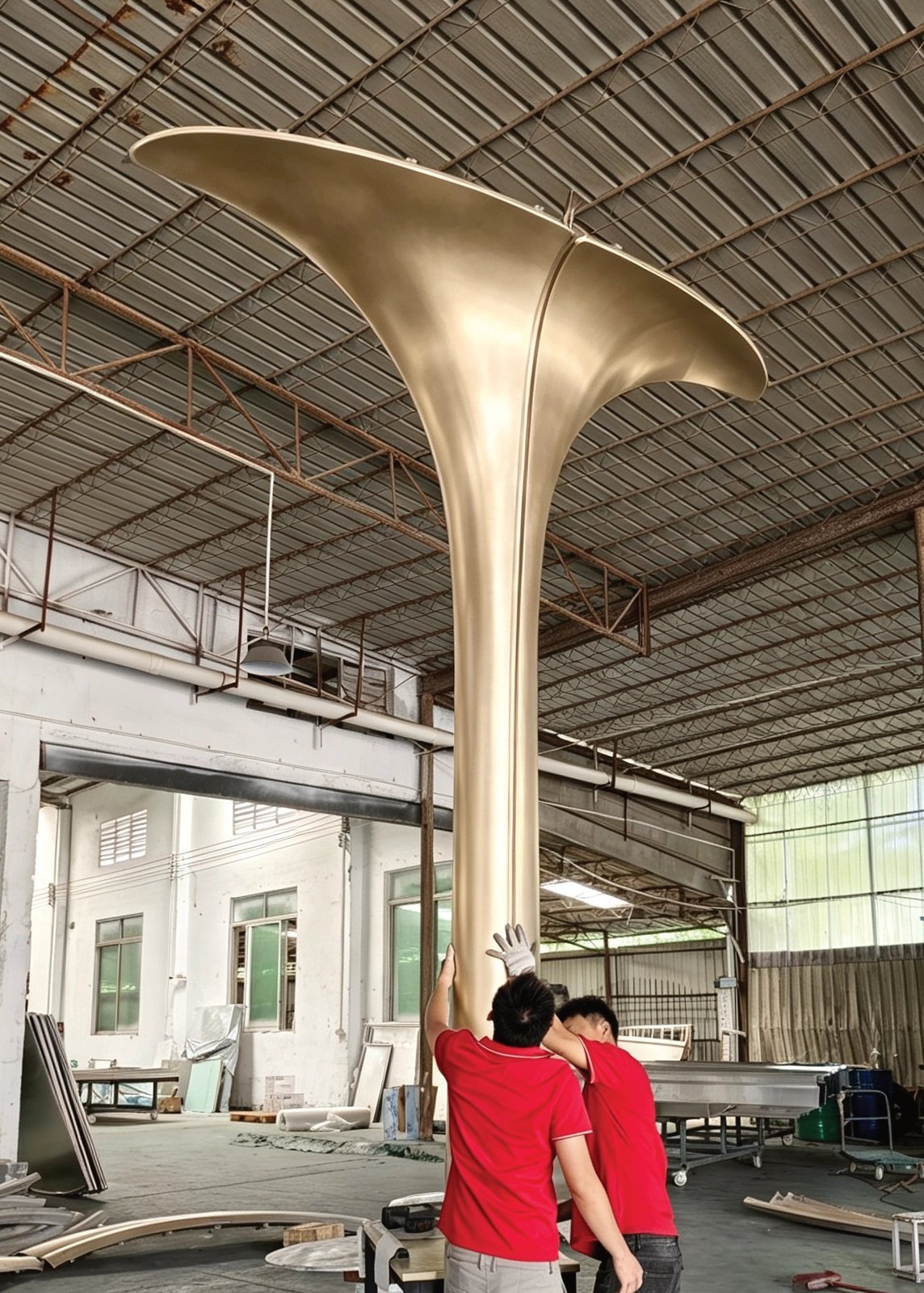
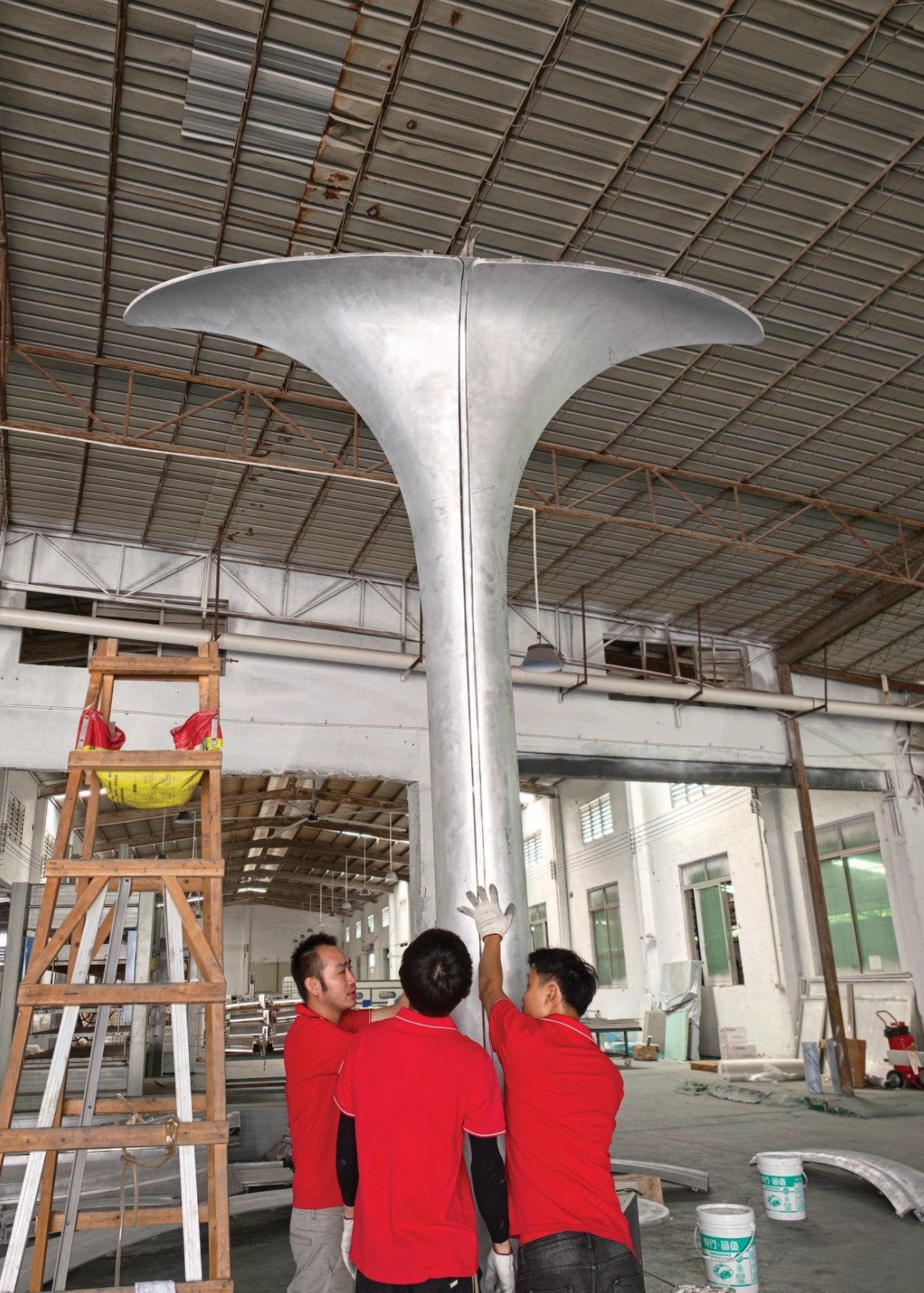
Cross-border install guidance is the unglamorous half. A Thai scaffold crew should not be welding hangers while guests walk the courtyard. LINDELACR trial-assembled the flare in Foshan—first in mill finish, then in gold—so seam, radius, and bracket pitch were proven before the container left. The same crew that nested the petals checked the first crate. That is factory support, not a PDF emailed after the ship sailed.
Numbered crates, not site improvisation
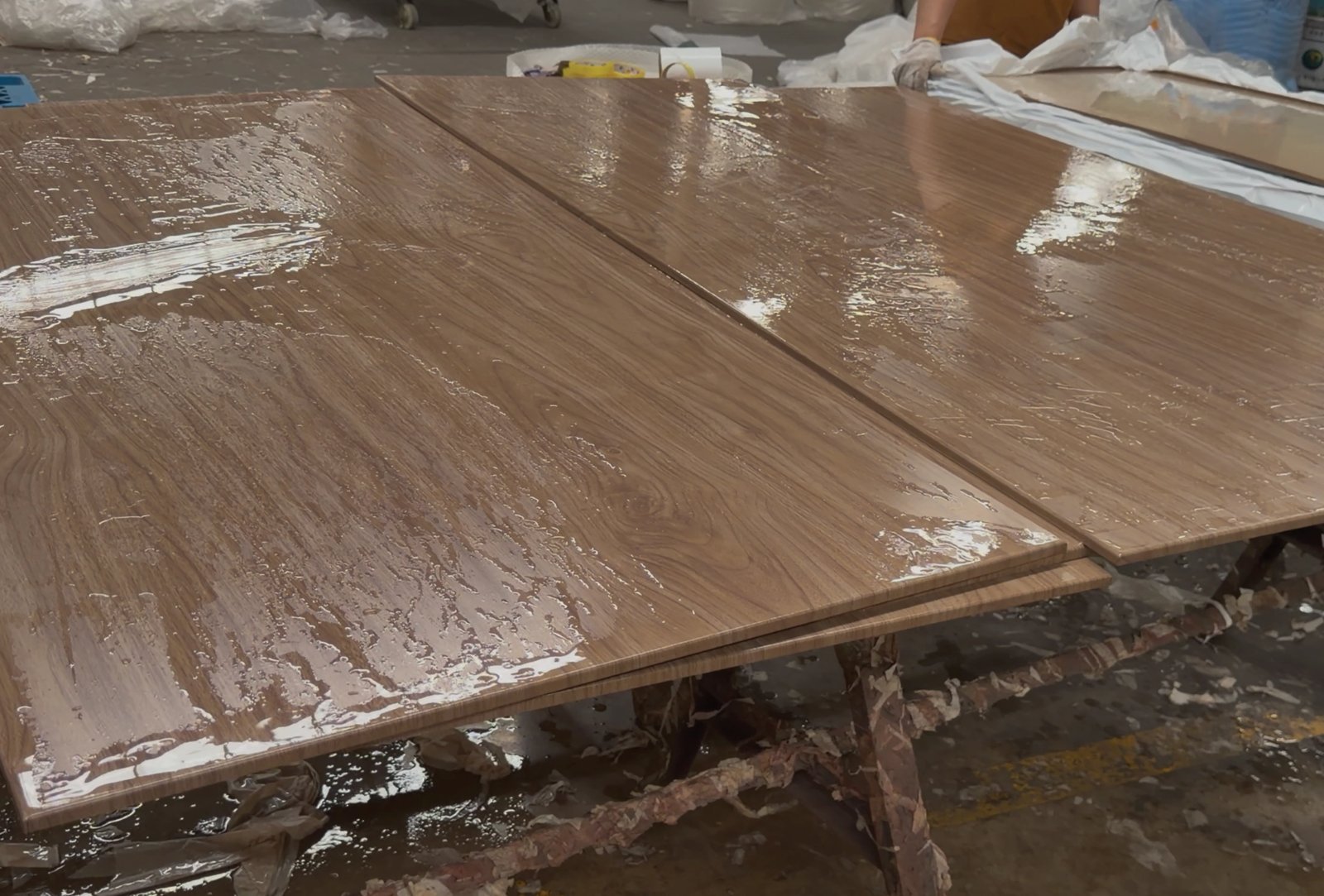
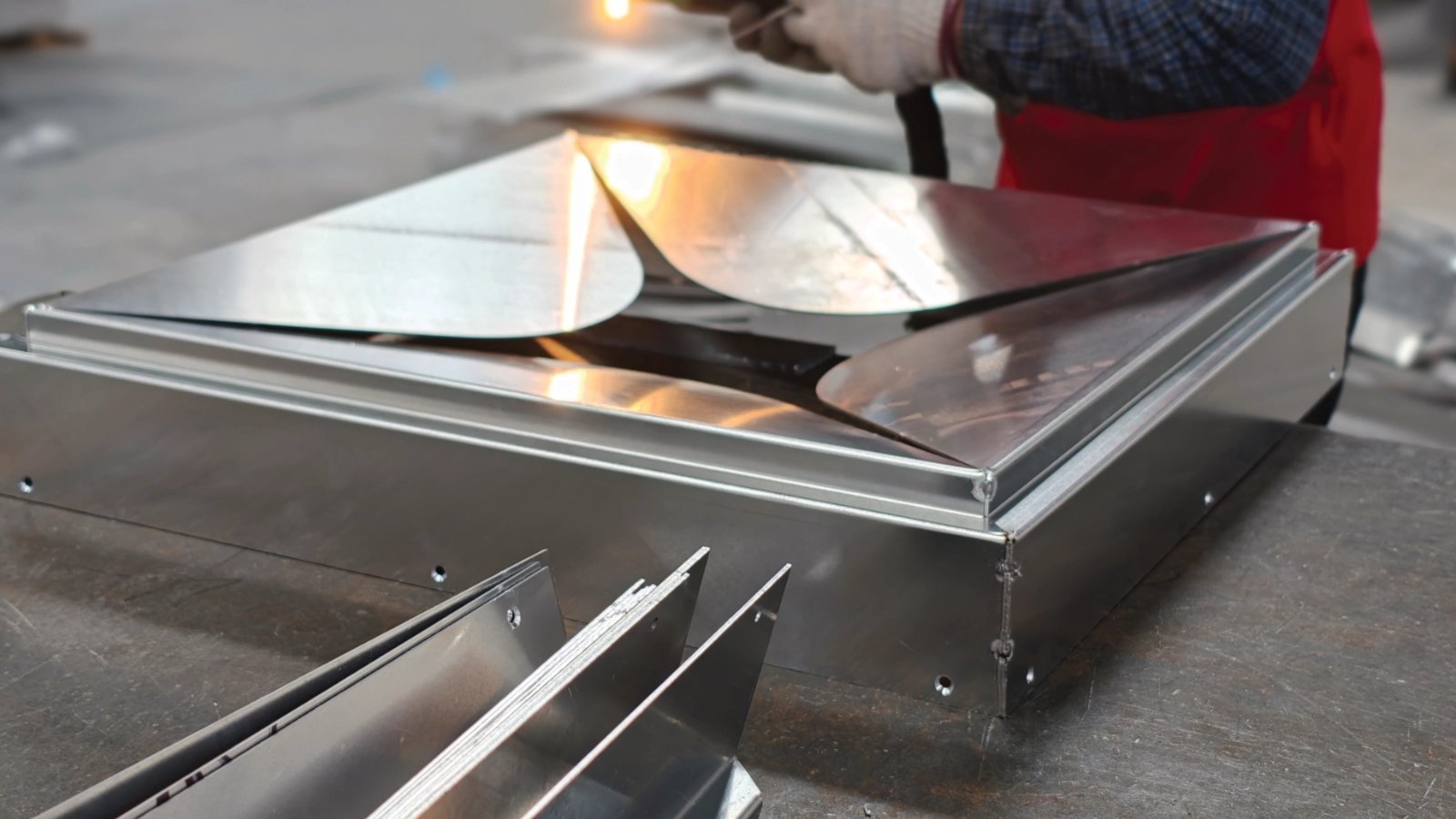
On the Foshan bench the petal is still silver. Four concave leaves sit in a square frame. Side flanges already have holes. L-shaped corner brackets are welded on, ground, and marked by hand—1, 2—so the Thai hang matches the drawing instead of a tape measure in humid air. The sequence is the same as other LINDELACR ceilings: scan or survey, CAD, CNC and fold, weld the 角码, coat, pack by zone.
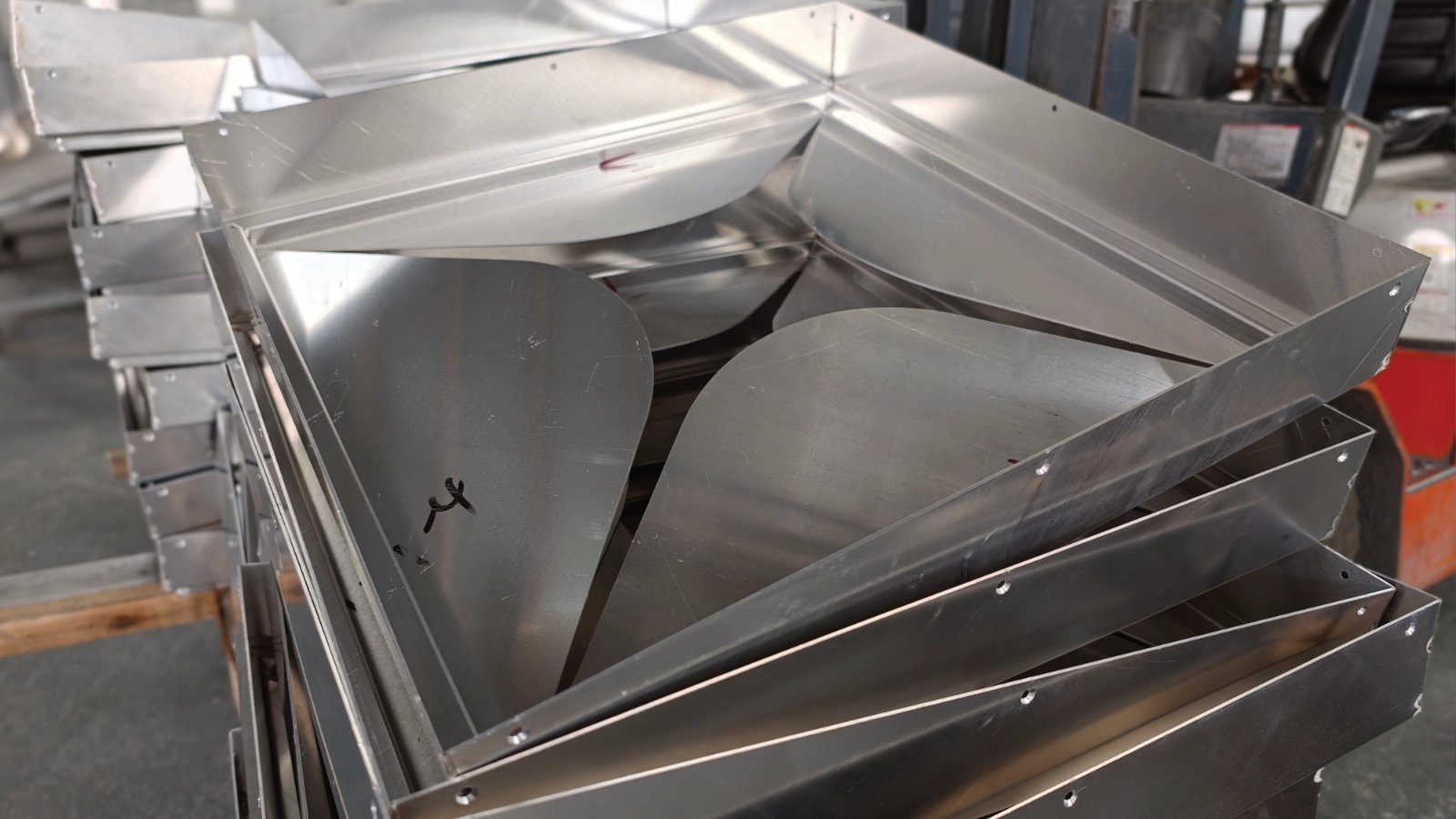
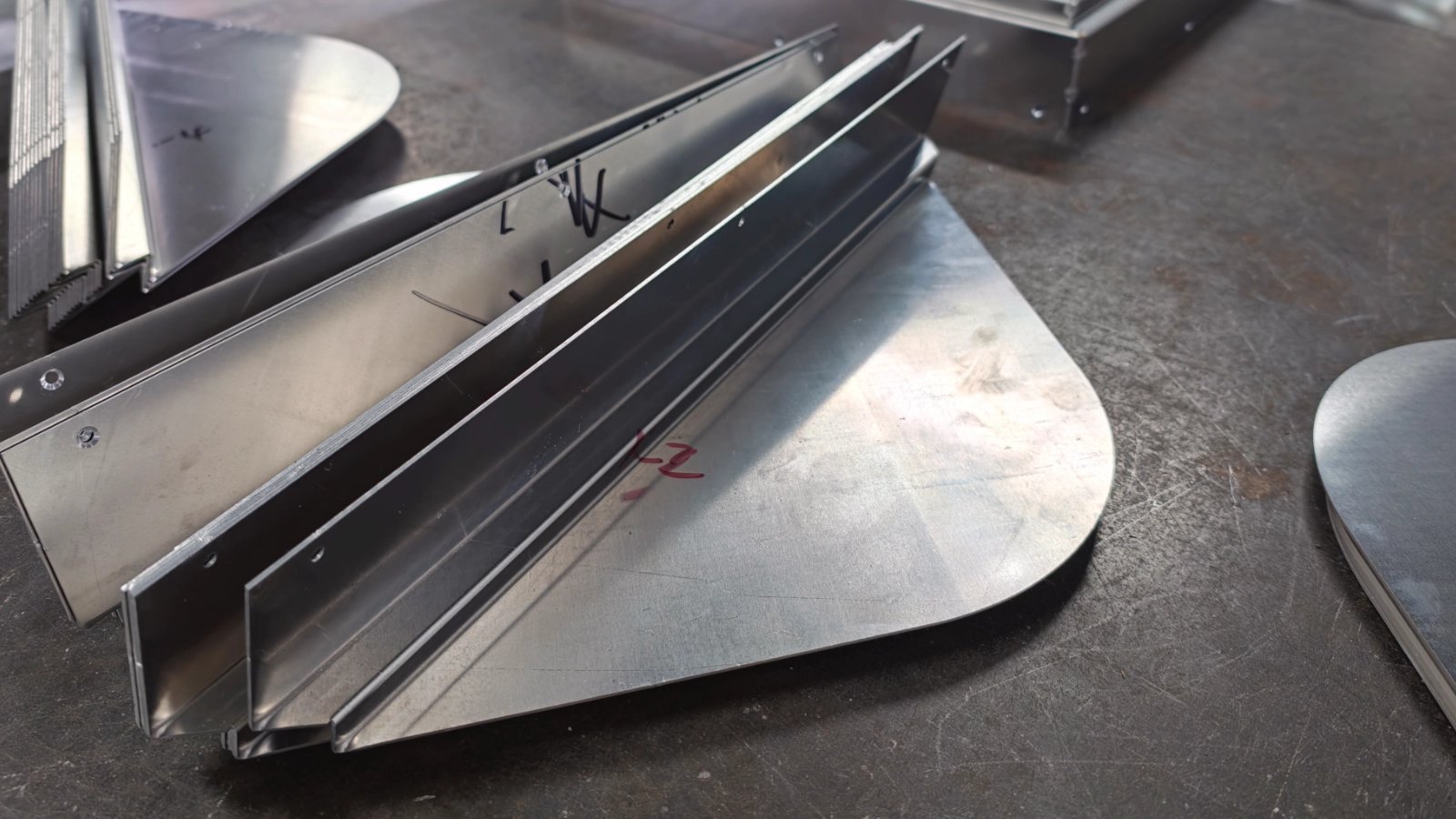
A hotel lobby this size fails when one gold shifts or one capital sits a module off. Numbering is cheaper than a second coating lot. The 20,000 m² plant already runs metal ceilings and column wraps on one process, which is why the petal field and the sixteen shafts can share a finish window.
Site hang: scaffold, codes, sensor lights
Install photos still show a tower scaffold beside a finished gold bay. That is the honest picture of a 1,800 m² canopy: hang proceeds bay by bay while the courtyard stays open. Junction lights are in the petal nodes before the crate leaves Foshan. They sense outdoor ambient and dim or lift so the gold does not glare at noon or go dead at dusk. LINDELACR does not publish a lux table for this hotel; the control logic belongs to the lighting package, the reserved lamp positions belong to the metal.
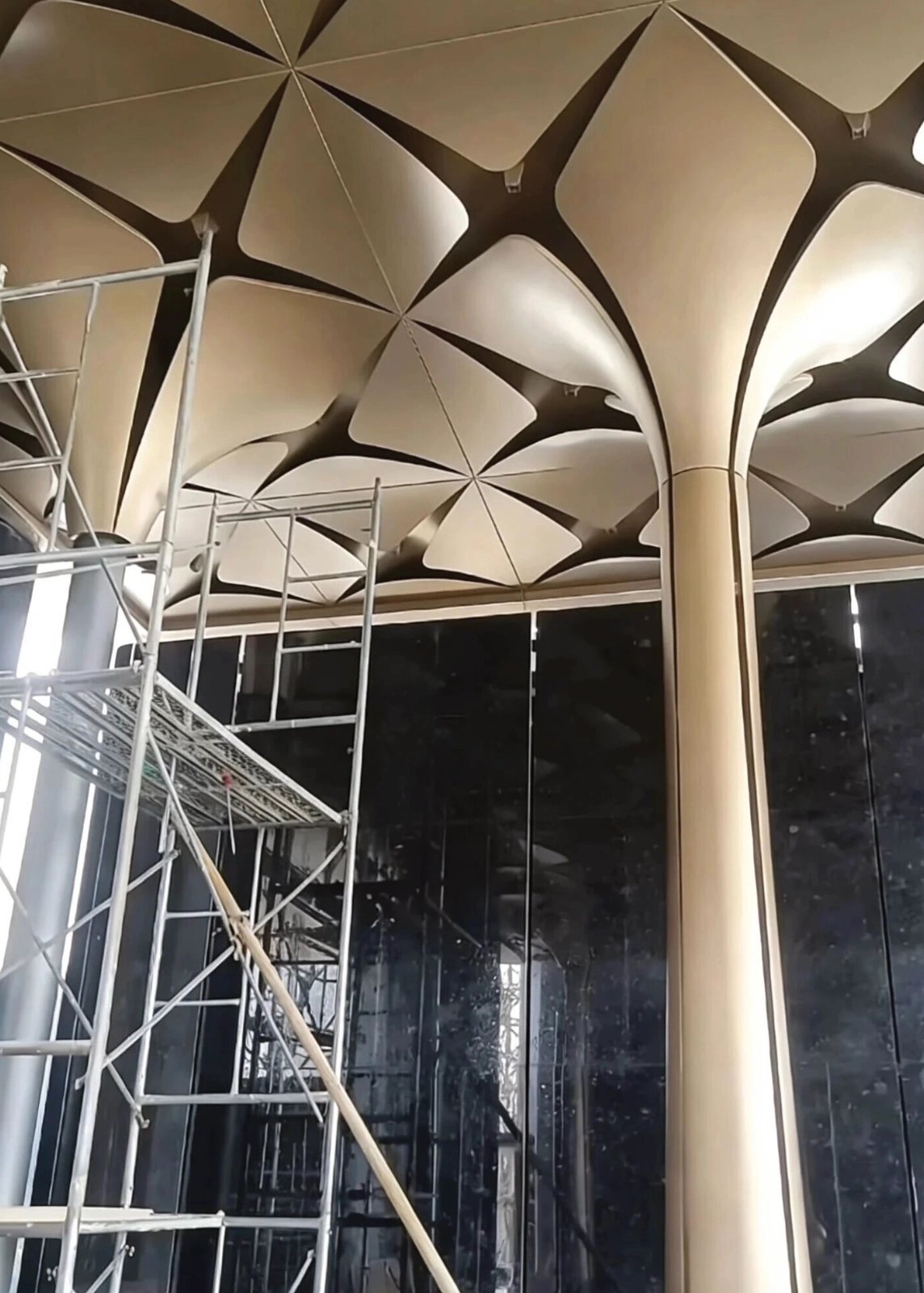
Guidance on site is matching codes, checking the first flare against the scan, and keeping one gold across replacements. The contractor hangs; the factory has already done the cuts that used to happen on the scaffold.
Frequently asked questions
What did LINDELACR supply for Thailand Golden Bay Resort Hotel?
A sculptural lobby package: 1,800 m² of champagne-gold 3D petal aluminum ceiling and sixteen flared aluminum column covers. LINDELACR advised the design, surveyed the site, scanned the scene, issued samples, and packed numbered modules with factory-fitted corner brackets.
What factory support did LINDELACR give on this Thailand hotel?
Design advice, field survey, 3D scan and scene restore, 1:1 samples, Foshan fabrication, and cross-border install guidance. Corner brackets were welded on in the plant and hand-coded so the Thai crew hung by number instead of cutting on scaffold.
How do the gold petals meet the sixteen column covers?
Each shaft is a multi-piece aluminum wrap that flares into a trumpet capital. The capital lands in the same champagne-gold petal field as the 1,800 m² soffit, so column and ceiling read as one canopy rather than a box column under a flat grid.
What should a hotel contractor send to price a similar petal ceiling?
Send lobby photos or a scan, column count and flare intent, target gold, and whether lights sit in the petal junctions. LINDELACR returns a module note, a sample plan, and a Foshan lead-time window from the 20,000 m² plant.
Request a petal-and-column shop file
If the next resort lobby needs a gold 3D petal canopy and flared column covers as one system, send the scan or as-built photos to LINDELACR. We will return a module, a sample, and a fabrication window from Foshan.